Thursday, 7 January 2010

Fractals in Corewar

Koch Curve in RedcodeIn 1997 Anton Marsden organised a Corewar tournament with a difference.  The three rounds challenged players to use Redcode to solve a variety of problems.

In the third round of Anton's Corewar Tournament the challenge was to write a Redcode program to draw a pretty picture.  First place was taken by Ilmari Karonen with a fractal fern.

Here's my own attempt at creating a pretty picture in the core view of pMARS. It's a fractal known as the Koch Curve.

Here's the program, just 18 instructions:

width equ 157

        org    koch

        stack equ count+30

koch:   mov    #2-ptr, >stack
        jmp    count,  }move

        sub.a  #2,     move
        mov    #2-ptr, >stack
        jmp    count

        jmp    return, }move

count:  djn    koch,   #11
        mod.a  #8,     move
        div.a  #2,     move
        add.b  *move,  pos
        mul.a  #2,     move
pos:    add    #1,     koch+71*width/2+16
return: mov.ba <stack, ptr
ptr:    jmp    0,      >count

move:   dat    -1
        dat    -width
        dat    1
        dat    width

Have you tried to write a graphical display in Corewar?

Tuesday, 27 October 2009

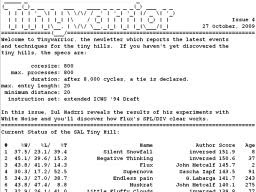
Tinywarrior Issue 4

Tinywarrior issue 4, corewarThe fourth issue of Tinywarrior has just been published, the newsletter which reports the latest events and techniques for the tiny hill. Here's what you can expect to find in this issue:

Flux and the SPL/DIV Clear by John Metcalf examines a SPL/DIV clear inspired by G2.

Larger Than Infinity by Zul Nadzri reveals the results of Zul's experiments with White Noise.

Any feedback would be greatly appreciated.

Tuesday, 25 August 2009

Maezumo, Evolving for the Corewar Tiny Hill with a Twist

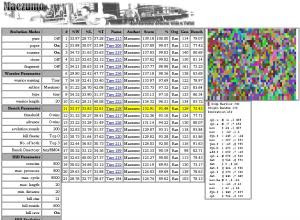
Maezumo, the Evolver with a TwistAt the beginning of August, Christian Schmidt released version 1.04 of Maezumo, his corewar evolver. If you're familiar with the old version the biggest difference you'll notice are the additions to the progress report.

Maezumo evolves warriors using traditional mutation, keeping a hill of the top warriors. Hill warriors are then injected back into the soup. Where Maezumo offers something innovative is in the hint modes.

If the hint modes are enabled, Maezumo generates warriors from inbuilt templates. These challenge the hill and if successful enter the soup for further enhancement by the mutation algorithm.

Maezumo is supplied with a Windows binary, Basic source code and all the necessary support files. To evolve for the tiny hill, I simply extracted the archived, changed the settings in maezumo.ini and double clicked maezumo.exe. I selected the scanner/paper hint mode to cover the two most successful tiny strategies.

After a 13 hour run, the top warrior on Maezumo's hill is an evolved style paper which scores 75 against SAL's tiny hill. I think it would be realistic to expect a strong tiny warrior after a 3 or 4 day run.

Have you tried Maezumo yet? If so, let me know your thoughts :-)

Thursday, 9 July 2009

TEV Hints and Another Evolved Bomber

Recently I've been experimenting with different hints in TEV0 and TEV12 hoping to guide the evolution of Redcode programs. TEV is a small program written in Basic and uses the principles of random mutation and survival of the fittest to create a Redcode program over a number of generations.

Redcode is the language of Corewar, a game in which two or more programs battle to control the memory of a virtual computer. Here's a quick introduction to Corewar. Traditionally programs are coded by hand, but a number of players have risen to the challenge of writing a program to evolve good contenders.

The purpose of a hint is to control the direction of evolution by issuing a score penalty for certain types of code. Here are the hints I've been experimenting with:

  • a penalty for three consecutive opcodes the same
  • a penalty for the first opcode being a SPL
  • a penalty for the a-mode of a SPL being #

This produced some really weird programs to begin with, but after relaxing the penalties stronger programs emerged. Unfortunately TEV still hasn't produced a decent replicator so instead here's the code for the most successful bomber of the latest run, medusa's mirror:

;redcode-nano
;name medusa's mirror
;author John Metcalf
;strategy evolved using TEV12 with hints
;assert CORESIZE==80

mov.i <46, $11
spl.i #-4, {56
mov.i <36, {79
mov.i {79, {54
djn.f $78, {59
end

Next I'm hoping to divide the pool into different regions and implement a different hint in each region. If you have any suggestions for hints, please let me know.